Comparisons of recreation and park amenities, budget, staffing, and acreage identified where Los Angeles is exceeding or being exceeded by other regional and national cities that have similar demographic or economic characteristics, similar climate, and more highly ranked park systems.
San Francisco and San Diego were chosen as regional peers, offering insights into how other California cities manage and fund their park systems. Chicago, New York City, and Dallas provide comparability in terms of size, population, density, land use, and urban parkland challenges, while Washington, D.C. serves as an aspirational model due to its consistently high ranked park system.
Peer City Benchmarking
San Francisco
Regional Peer City, Aspirational Park System| Population |
835,689 |
| TPL 2025 ParkScore | 6 |
| Residents in 10-min Walk | 100% |
Chicago
Large Population Peer City| Population |
2,672,258 |
| TPL 2025 ParkScore | 11 |
| Residents in 10-min Walk | 98% |
New York
Large Population Peer City| Population |
8,562,125 |
| TPL 2025 ParkScore | 13 |
| Residents in 10-min Walk | 99% |
Washington
Aspirational Park System| Population |
691,893 |
| TPL 2025 ParkScore | 1 |
| Residents in 10-min Walk | 99% |
Dallas
Similar Density Peer City| Population |
1,313,550 |
| TPL 2025 ParkScore | 34 |
| Residents in 10-min Walk | 81% |
San Diego
Regional Peer City| Population |
1,389,772 |
| TPL 2025 ParkScore | 22 |
| Residents in 10-min Walk | 81% |
Los Angeles
| Population |
3,828,383 |
| TPL 2025 ParkScore | 90 |
| Residents in 10-min Walk | 62% |
Los Angeles was benchmarked against peer cities in California; cities of similar size, population, density, land use, and urban parkland challenges; and cities with aspirational recreation and park systems.
Recreation and Park Amenity Benchmarking
Population-based level of service (LOS) is a measure of how many park and recreation amenities a city has. It is typically expressed as a ratio of number of amenities to population, allowing comparison across cities of different sizes and across different time periods as populations change.
Current Level of Service
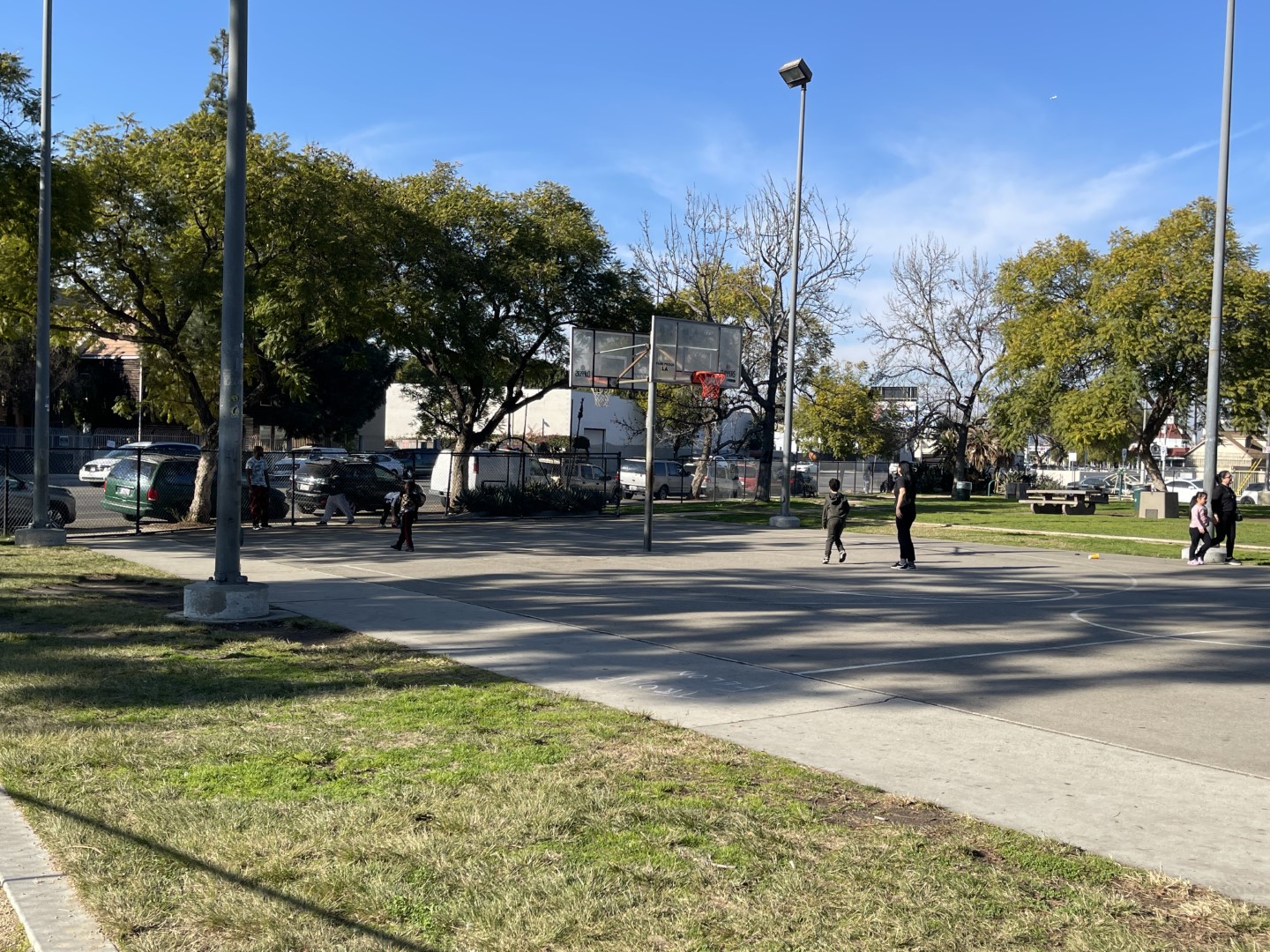
Los Angeles’ current level of service is based on the inventory of RAP amenities. Amenities that have two, non-simultaneous uses (e.g., pickleball courts overlaid on tennis courts) are counted as half an amenity for each use.
The level of service for peer cities is based on the Trust for Public Land’s 2025 City Park Facts, which includes self-reported amenity counts for the 100 most populous cities in the country. The median of the peers’ levels of service was used for comparison.
See the Level of Service Standards for the new level of service standards defined by the PNA.
| Level of Service | ||||||||||
|---|---|---|---|---|---|---|---|---|---|---|
| Amenity | Total RAP Count | Metric | Los Angeles | Peer Median LOS | San Francisco | San Diego | Dallas | Chicago | New York | Washington |
| Basketball Hoops | 692 | 1/10,000 | 1.8 | 3.8 | 3.9 | 3.5 | 4.1 | 3.6 | 3.4 | 6.6 |
| Community Gardens | 19 | 1/1,000 | 0.0 | 0.0 | 0.1 | 0.0 | 0.0 | 0.0 | 0.0 | 0.2 |
| Diamond Fields | 304 | 1/10,000 | 0.8 | 1.0 | 0.7 | 0.5 | 1.0 | 2.6 | 0.9 | 1.2 |
| Disc Golf Courses | 3 | 1/100,000 | 0.1 | 0.2 | 0.2 | 0.2 | 0.3 | 0.1 | 0.2 | 0.1 |
| Nature Trails (Miles) | 92 | 1/100,000 | 2.4 | 3.6 | 5.9 | 20.2 | 2.4 | 3.6 | 3.7 | 0.6 |
| Off-Leash Dog Parks | 14 | 1/100,000 | 0.4 | 2.0 | 5.0 | 1.9 | 0.7 | 1.2 | 2.0 | 2.7 |
| Park Acreage | 16,333 | 1/1,000 | 4.3 | 9.9 | 7.7 | 31.1 | 17.8 | 4.7 | 3.8 | 12.1 |
| Pickleball Courts | 52 | 1/20,000 | 0.3 | 1.0 | 1.2 | 0.2 | 1.1 | 1.0 | 0.1 | 1.2 |
| Playgrounds | 398 | 1/10,000 | 1.0 | 1.9 | 2.5 | 1.4 | 1.6 | 1.9 | 2.0 | 1.9 |
| Recreation and Senior Centers | 185 | 1/20,000 | 1.0 | 0.9 | 0.9 | 0.9 | 0.6 | 1.9 | 0.4 | 2.1 |
| Rectangular Fields | 109 | 1/10,000 | 0.3 | 0.7 | 0.4 | 0.1 | 1.2 | 1.1 | 0.5 | 0.9 |
| Restrooms | 1,618 | 1/10,000 | 4.2 | 1.6 | 3.8 | 1.8 | 1.0 | 1.3 | 0.9 | 2.8 |
| Skate Parks | 29 | 1/100,000 | 0.8 | 0.7 | 0.8 | 0.9 | 0.1 | 0.2 | 0.5 | 0.9 |
| Splashpads | 13 | 1/100,000 | 0.3 | 3.5 | 1.3 | 0.1 | 1.3 | 9.1 | 6.9 | 5.8 |
| Swimming Pools (Outdoor) | 59 | 1/100,000 | 1.5 | 1.4 | 1.4 | 1.1 | 1.4 | 3.0 | 0.8 | 5.5 |
| Tennis Courts | 278 | 1/20,000 | 1.4 | 3.1 | 4.5 | 2.1 | 4.1 | 2.2 | 1.6 | 6.4 |
| Volleyball Courts | 175 | 1/20,000 | 0.9 | 0.2 | 0.0 | 0.8 | 0.2 | 0.3 | 0.2 | 0.4 |
Financial Benchmarking
Benchmarking RAP’s budget and operations against the same peer park systems provides valuable insight into how Los Angeles’ investment in parks compares to other major cities and highlights opportunities for improvement. By examining the operating budgets, capital funding amounts, and private funding models of similar park systems, we can better understand where RAP falls short and identify potential strategies to enhance funding, and in turn, staffing and service delivery.
| Los Angeles | San Francisco | San Diego | Dallas | Chicago | New York | Washington | |
|---|---|---|---|---|---|---|---|
| Annual Budget (2023) | $355M | $486M | $215M | $301M | $493M | $1B | $274M |
| % of City Budget (2023) | 3% | 4% | 4% | 7% | 4% | 1% | 1% |
| Park System Area, Acres (2023) | 16,000 | 4,000 | 42,000 | 21,000 | 9,000 | 30,000 | 9,000 |
| Full-Time Staff per Acre | 0.10 | 0.49 | 0.02 | 0.07 | 0.36 | 0.16 | 0.10 |
| Per Capita Public Investment | $92 | $583 | $155 | $232 | $182 | $137 | $407 |
The adopted budgets for Fiscal Year 2023 were used as the basis for comparing operating budgets, as this was the most recent year for which American Community Survey data were available to standardize population figures. Additionally, the benchmarking section incorporates data from Trust for Public Land (TPL) City Park Facts (2023) to provide further insights into capital investment from other public agencies and park investments by private entities within peer cities. 1“2024 City Park Facts,” Trust for Public Land.
Public Per-Capita Investment
Public per-capita investment was calculated by looking at annual operating budgets (FY 2023) and capital costs from TPL data (2023). At $92 per capita, LA’s per-capita investment is lower than all other benchmarked cities. By comparison, the benchmarked cities average $283 of per-capita public investment in parks.
Full-Time Staff per Acre
RAP also has a lower full-time staff per acre compared to San Francisco, Chicago, and New York City. Compared to other cities, RAP staff already have a greater workload because LA parks operate at more consistent levels of visitation year-round and most RAP programming and maintenance are handled in-house.
Public and Private Investment
Compared to Los Angeles, most peer park systems receive significant supplemental funding from other public agencies or private sources, strengthening their ability to maintain and enhance park facilities. San Francisco’s park system is supported by a robust network of state, regional, and national entities, such as the Presidio Trust and the Golden Gate National Recreation Area, which provide 20% of the funding and stewardship for parks and open space in the city. The New York City park system is augmented by private investment through prominent conservancies and value capture mechanisms. Dallas has a strong philanthropic culture of supporting parks as part of quality of life in the city. Without substantial philanthropic support or partnerships with other public agencies, the City of Los Angeles primarily relies on City funding mechanisms to sustain RAP and the park system.
Sources
- 1“2024 City Park Facts,” Trust for Public Land.