Skip to content

Did you know?

RAP will use the PNA as a guide to make equitable, effective, and lasting improvements across the park system over the next 20 years.

LA's park system has fallen to 90th out of the 100 largest cites' park systems in the country.

The PNA identifies strategies to maintain, improve, and expand LA's diverse network of parks, facilities, and programs.

Did you know?

RAP’s budget has not kept pace with inflation, even as park acreage and the department’s obligation to reimburse the General Fund for staff benefits and utilities has grown. Additionally, some critical funding sources will expire in the next few years.

RAP and the City of Los Angeles will pursue a variety of strategies to increase funding for parks.

The PNA identifies a need for $558 million annually to cover staffing, operations, and General Fund reimbursements. The current budget is approximately $350 million, more than half of the need.

The PNA identifies a need for $15 billion in one-time capital spending to catch up on deferred maintenance and to meet level of service goals.

Did you know?

The PNA identifies specific staffing needs for native habitat management and ecologists, accessibility managers, park rangers, and park ambassadors.

Since 2008, RAP’s full-time staff has decreased by over 25%.

RAP will work to overcome recruitment and retention difficulties due to limited resources and lower wages compared to other departments.

Did you know?

The PNA prioritizes existing and prospective park sites across the City using indicators of park need, park pressure, and facility condition as well as social and environmental equity, resilience, and alignment with other City and County initiatives.

Given current funding challenges, prioritization and decision-making tools are critical to be able to say “these sites and neighborhoods need attention first.”

RAP will use the PNA’s prioritized list of 518 park sites and new park priority areas to be proactive in decision-making about where to invest first.

Did you know?

Most Angelenos agree that parks, trails, recreation facilities, and programs provide a wide range of benefits.

The PNA pulls together resident sentiments and research documenting the benefits recreation and parks provide in improving health and wellness, supporting childhood development, offering economic opportunity, and helping build strong, resilient communities.

RAP will use these findings and research in marketing and communications as well as to secure additional funding for recreation and parks.

Did you know?

Less than half of Angelenos feel that there are enough parks and/or recreation centers within walking distance of their home.

RAP will use the PNA’s guidelines for ongoing engagement to help parks reflect the diverse needs and priorities of Los Angeles’ many neighborhoods.

The PNA was shaped by the participation of thousands of Angelenos in surveys, in-person meetings, workshops, and events.

Did you know?

There are different needs and pressures in different parts of the City, from disparities in park access and recreational resources to differences in community priorities.

The PNA documents different issues and preferences in four geographic regions of the City.

RAP will use the regional snapshots to tailor its actions to the needs in different parts of the City.

Did you know?

While LA’s park system continues to expand, the City currently has just 4.2 park acres per thousand residents—the lowest ratio since the 1870s—and generally offers far fewer amenities per capita than its peers.

The PNA guides how many amenities are needed through newly-developed benchmarks, called level of service standards.

RAP will use the level of service standards to guide decisions about what additional amenities are needed.

Did you know?

RAP’s annual assessment of recreation amenities does not currently take into account site design and function.

RAP will use the PNA’s site planning guidelines to ensure that parks across Los Angeles are not only functional and beautiful but also aligned with community expectations.

The PNA’s site planning guidelines help establish consistent principles for design, connectivity, sustainability, and access.

Did you know?

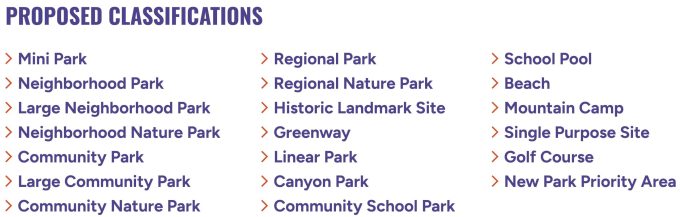
Prior to the PNA, all of the City’s parks were categorized into only three classifications.

RAP will use the classifications to clarify how existing parks function and set expectations about how future parks can meet residents’ needs.

The PNA includes new park classifications to expand the vocabulary we use to refer to the various types of parks in the city.

Did you know?

As the city continues to grow and change, it will require sustained investment to maintain, improve, and expand its diverse network of parks, facilities, and programs.

The PNA provides both long-term guidance and day-to-day tools for managing the city’s recreation and parks system.

RAP will implement the PNA and update it on a recurring basis.

A Vision for LA Parks

LA’s parks help us thrive everyday by providing spaces to play, learn, and connect in nature.

Parks are for all Angelenos.

They connect us to nature, to the mountains and the ocean, to each other. They are places to escape the heat, attend festivals, see coast live oak trees, eat carne asada, and paddle in swan boats with family and friends. They are our front and backyards, the places we instinctively gravitate to. They knit the very fabric of our city together and make it feel like home.

From a young age, playgrounds transform into the backdrops for endless imaginative adventures, and open fields provide the perfect setting for impromptu soccer games with friends. The laughter, the friendly competition, the sheer joy of running freely are experiences not just about physical activity but about building friendships, learning teamwork, and fostering creativity that are foundational to social and emotional development for children of all cultures, abilities, and socioeconomic statuses.

As we get older, parks evolve with us. Impromptu games give way to tournaments and our imaginations runs wild with what to grow in community garden plots. Nature becomes our sanctuary. These experiences nurture our bodies and build community. The ability to disconnect from screens and pressures allow us to clear our heads, gain perspective, and promote calm and clarity. Parks become vital outlets for mental well-being–spaces for both quiet introspection and fostering a greater sense of community.

For over two centuries, LA’s parks have been indispensable pillars in our communities. As our city changes and grows, and our society becomes more aware of the diversity of perspectives, experiences, needs, and abilities within our community, our parks will evolve so that they continue to enrich our lives and help us thrive.
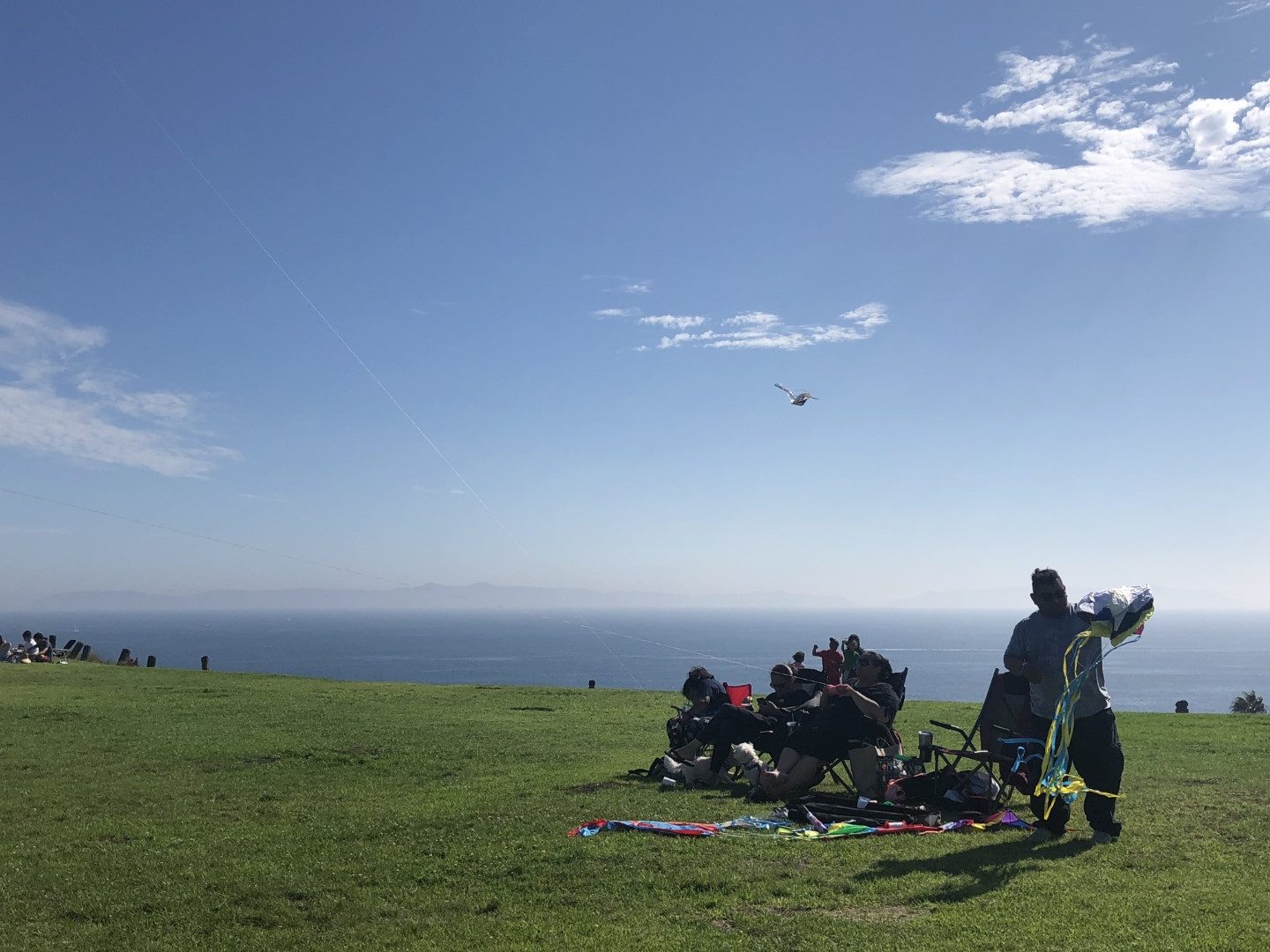
A group of people relaxes in folding chairs on a grassy hill, overlooking a vast ocean. A person stands holding a kite or a string of flags. A single white kite flies high in the clear blue sky, which has a few white clouds. A mountain range is faintly visible on the distant horizon.
People flying kites at Angels Gate Park.
Connie Chung/HR&A, 2025.

Through these shared spaces, parks enrich our lives and help us thrive.

Explore the draft PNA

Get Involved!

Be part of the planning process for the City of Los Angeles Park Needs Assessment! You can participate by attending a community event, pop-up, taking the online survey, or by writing to the team directly to let us know your thoughts, concerns, and big ideas. 

Thanks to everybody who submitted comments on the Draft PNA!

Thanks for joining us at the phase 3 community meetings and pop-ups!

We appreciated hearing your thoughts on what you love about LA City Parks, how you use these vibrant spaces, and where you’d like to see improvements. Your feedback helps guide the future of these important City resources.

View the Phase 3 Recordings and Materials Here!

Previous Community Meetings

Our in-person meetings included a presentation and interactive tables where you could read and discuss the draft PNA. Food and Spanish translation were provided at all meetings.

September

THUR
4

Bellevue Recreation Center

6:00–8:00p

826 Lucile Ave
Los Angeles, CA 90026

Get Directions

SAT
6

Westwood Recreation Center

10:00a–12:00p

1350 S Sepulveda Blvd
Los Angeles, CA 90025

Get Directions

TUE
9

General Virtual Community Meeting and Q&A

Our general virtual community meeting will include a presentation and interactive Q+A session via Zoom.

6:00–7:30p

Via Zoom

WED
10

Topical Virtual Meeting – Budgets, Cost Estimates, and Decision Making

Our deep-dive virtual meetings will include more specific discussions on various topics pertaining to LA Recreation and Parks via Zoom.

6:00–7:30p

Via Zoom

THUR
11

Topical Virtual Meeting – Classifications, Level of Service, and Guidelines

Our deep-dive virtual meetings will include more specific discussions on various topics pertaining to LA Recreation and Parks via Zoom.

6:00–7:30p

Via Zoom

THUR
18

Topical Virtual Meeting – Prioritization

Our deep-dive virtual meetings will include more specific discussions on various topics pertaining to LA Recreation and Parks via Zoom.

6:00–7:30p

Via Zoom

Previous pop-ups

September

SUN
14

CicLAvia – Historic South Central meets Watts

Connecting Historic South Central, Florence Firestone, and Watts. We’ll be at the PlayLA Booth at the Watts Hub.

9:00–3:30p

More Info Here!

FRI
26

North Hollywood Senior Center Fiesta Party

11:00a–2:00p

5301 Tujunga Ave. North Hollywood, CA 91601

Get Directions

SAT
27

2025 Los Angeles Congress of Neighborhoods Exhibitor Fair

10:00a–4:00p

More Info Here!

Los Angeles City Hall, 200 N Spring St, Los Angeles, CA 90012

October

THUR
2

Pop-Up at Felicia Mahood Multipurpose Center

10:30a–12:30p

11338 Santa Monica Blvd, Los Angeles, CA 90025

Get Directions

THUR
9

Pop-Up at Rancho Cienega Recreation Center

5:00p–7:00p

5001 Obama Blvd, Los Angeles, CA 90016

View the presentation from the Phase 3 virtual meeting

View the Phase 3 Recording

View the presentation from the Phase 2 virtual meeting

View the Phase 2 Recording

View the presentation from the phase 1 virtual meeting

View the Phase 1 Recording

Neighborhood Council Reports

City of LA Neighborhood Councils are an important part of this project because they have a great sense of Park Needs in their neighborhoods!

We requested a short report from each of the 99 Neighborhood Councils that includes their priorities. Councils were able to choose to submit a report, which was requested no later than June 2, 2025. Each Neighborhood Council received an email request. If you cannot locate your neighborhood council’s email request, please let us know at LACityParksNeeds@theolinstudio.com.

Read the Reports Here

We presented to the LA Neighborhood Council Coalition at the April 4, 2025, standing meeting.

Submit a Comment on the PNA
Download the PNA PDFs
Sign Up for Project Updates

Translate This Site
Follow Us
Back To Top