Skip to content
The following is a framework for how RAP should report progress toward fulfilling the needs and priorities identified in the PNA.

RAP should hire dedicated full-time staff responsible for steering and tracking the progress of PNA implementation.

Every 5 Years

Every five years, RAP should complete a public status report on progress toward fulfilling the needs identified in the PNA.

The status report should publish results about the number and location of prioritized parks or new park locations that have received additional operations and maintenance or capital funding and total dollars spent, allocated, and requested. Reports should also include projections in funding shortages and strategy toward securing more sustainable funding. Qualitative descriptions should be included that describe progress on actions that may be less reflected by dollars spent, such as workforce development, the success of recreational and social service programs, collaboration with local NGOs/CBOs, and equity principles.

The following tasks should be completed by RAP staff for the five-year status report:
  • Compile list of completed and planned projects, with dollars spent on, dollars allocated yet unspent on, and projected dollars needed to complete each project. Include hard and soft costs as well as operations and maintenance funding allocated annually compared to projected budget needs.
  • Cross reference completed projects with the park prioritization list and report which priority tier level completed projects are within.
  • Provide updates on progress toward equity metrics and goals, with specific attention to sites scoring a 1 on the Environmental, Social, and Health Equity criterion.
  • Report on level of service improvements or losses in the full park system.
  • Write a short qualitative description of each completed project, including successes in relation to community engagement, workforce development, or other items that may be less well understood based on the financial report.
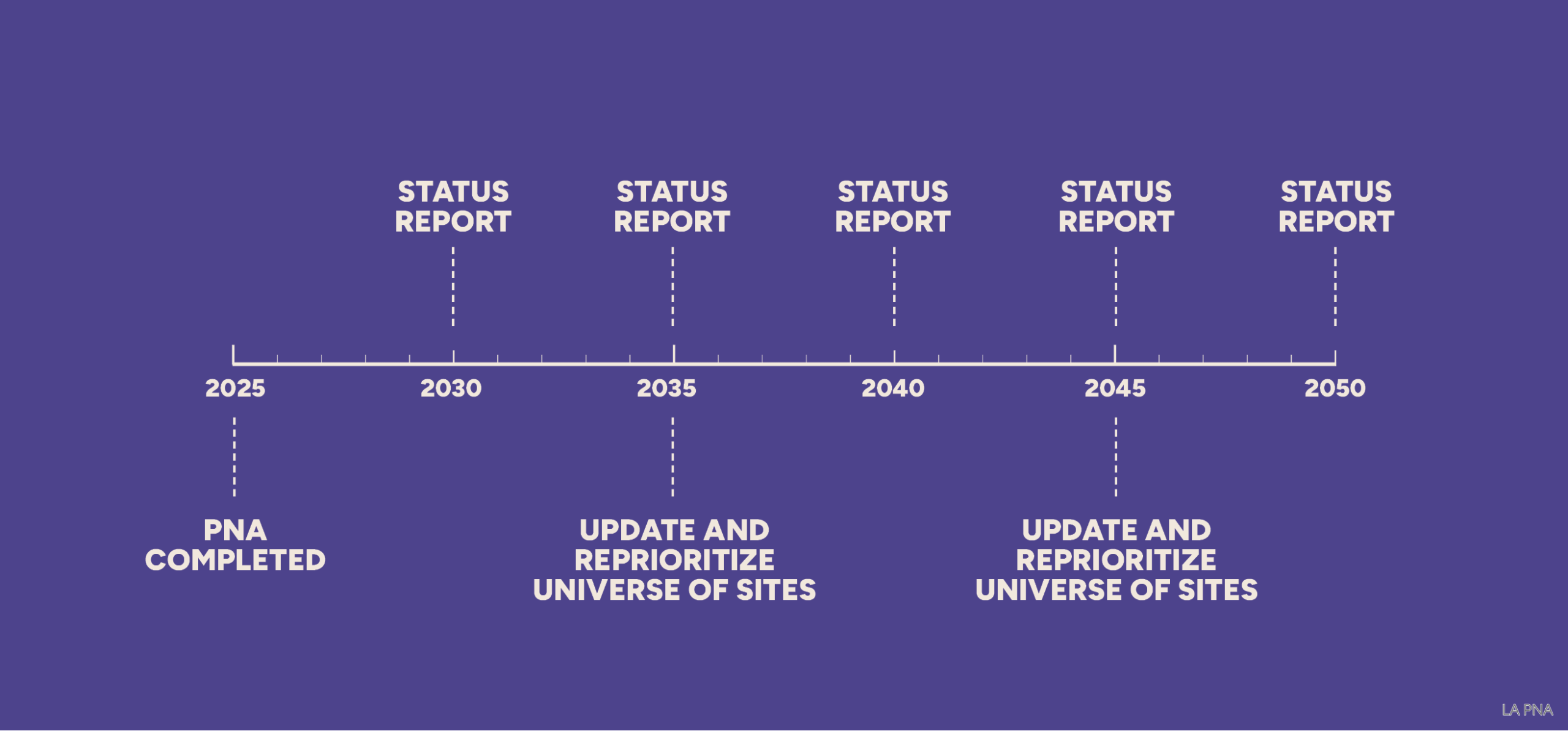
A purple timeline graphic charts the LA Park Needs Assessment milestones from 2025 to 2050, showing the PNA completion in 2025, recurring status reports every five years, and updates to reprioritize sites in 2035 and 2045.
The timeline for updating the PNA includes 5- and 10-year milestones.
OLIN, 2025.

Every 10 Years

Every ten years, RAP should engage a consultant to update the Universe of Sites and re-prioritize the Universe of Sites using:

  • Datasets with regular update intervals (example: CalEnviroScreen)
  • Parks conditions assessments
  • Results from a new statistically valid survey
  • Park visitation data

Where updated data are unavailable, existing datasets may be retained temporarily to ensure continuity and efficiency in analysis.

As the population projections used in the 2025 PNA are for 2050, by 2045 RAP should evaluate if an entirely new PNA is needed or if the current methodology is still valid. RAP should work toward the updated or new PNA by 2050. It is anticipated that the current methodology may still be valid but changes to the criteria may be needed to account for additional factors. All criteria should be updated in 2050.

In the event that population projections from the Southern California Association of Governments substantially change between now and 2045, RAP may want to consider a more substantial update sooner than 2045.
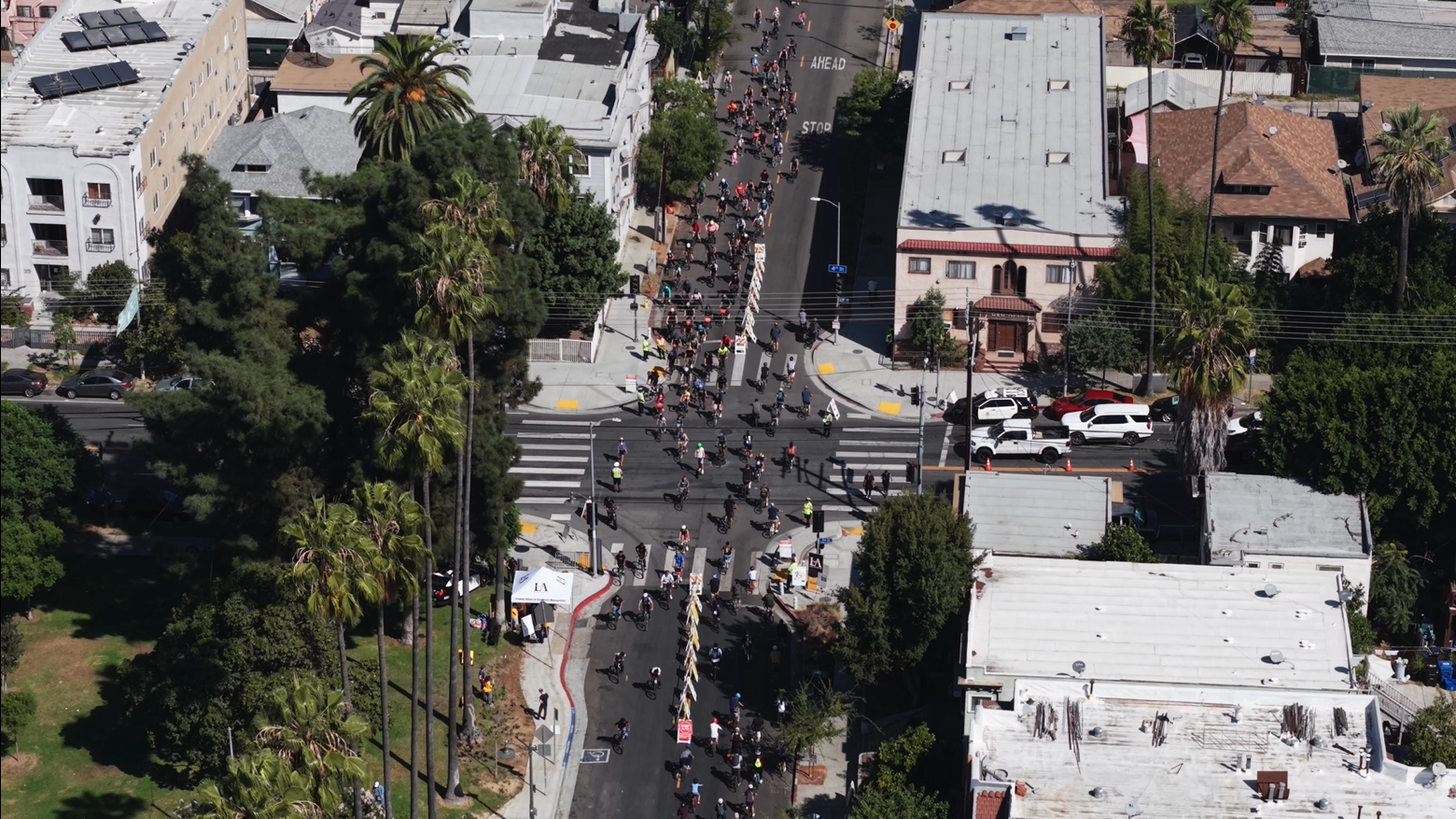
Aerial view of a city street lined with trees and buildings, crowded with people walking and biking for an event.
Hollenbeck Park became a hub of activity during the CicLAvia – Heart of LA event in October 2025.
Source: Calvada Surveying, Inc., 2025.
Submit a Comment on the PNA
Download the PNA PDFs
Sign Up for Project Updates

Translate This Site
Follow Us
Back To Top